AITO 4.9 Excellent Rating
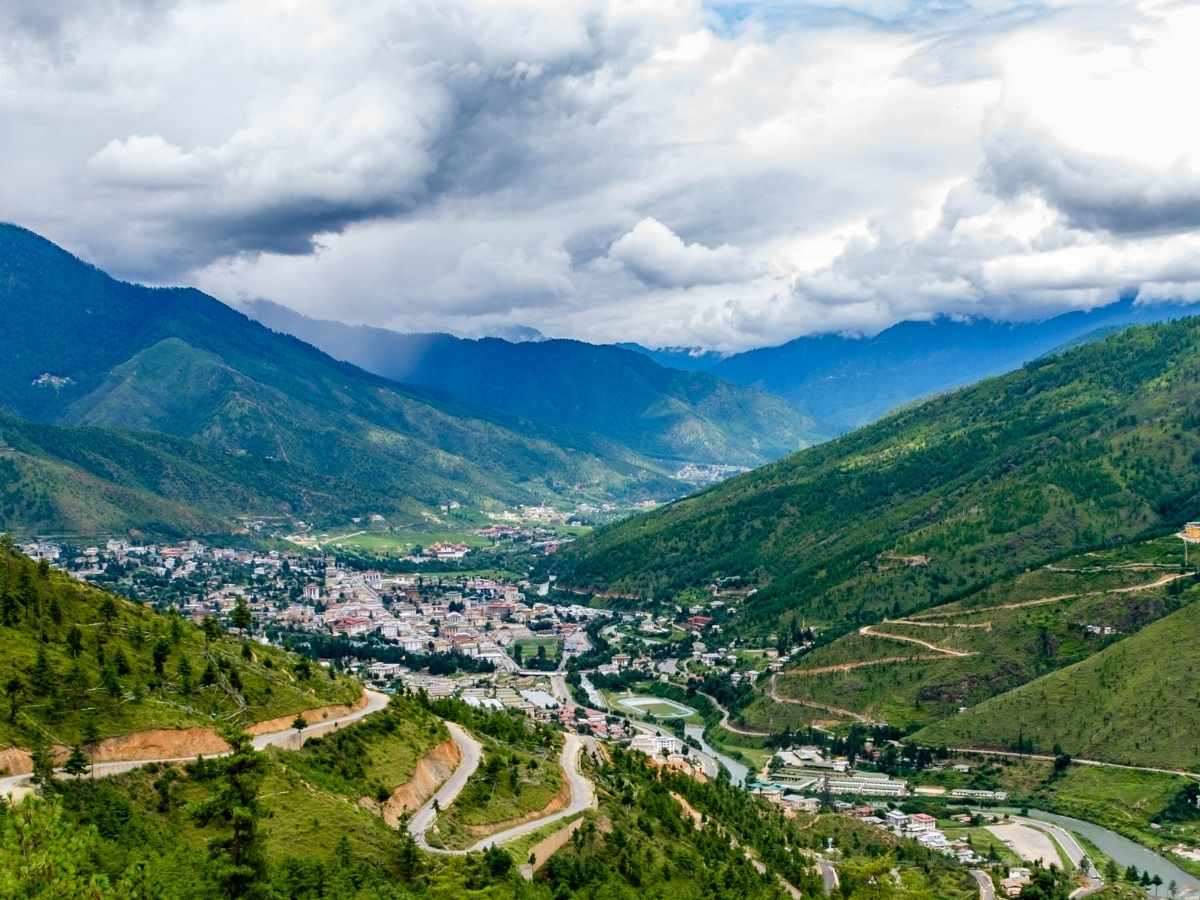

A Bhutan itinerary typically follows a single mountain road connecting the western valleys of Paro, Thimphu, and Punakha — the core of any first visit. A 7-day Bhutan itinerary covers this classic loop, including the Tiger’s Nest hike and Punakha Dzong, but does not reach the eastern valleys. Stretching to 10 or 13 days adds the Phobjikha Valley and Bumthang, the spiritual heartland of the country. All travel must be booked through a licensed tour operator, with a government Sustainable Development Fee paid per night. Spring (March–May) and autumn (September–November) are the most popular seasons, with major festivals such as Paro Tshechu and Thimphu Tshechu falling during these periods.
Tucked between India and Tibet, Bhutan is one of the most carefully protected places on Earth. The Land of the Thunder Dragon only opened to tourists in 1974, and even now it sets its own pace. There are no fast roads, no chain hotels, and no way to wander the country alone. Every traveller comes through a licensed guide, every road bends with the mountain, and every dzong courtyard hums with the slow weight of Buddhist tradition.
That makes planning a Bhutan trip a little different from anywhere else. You are not just choosing places to see. You are choosing how much of the country you can reach in the time you have, and how much of it you want to truly feel. This bhutan travel itinerary walks through the classic route from Paro to Punakha, the rewards of pushing further east into Bumthang and the Phobjikha Valley, and what a Bhutan itinerary for 7 days can and cannot deliver. It is written for the traveller who would rather discover Bhutan slowly than tick off a list.
Why Bhutan Rewards a Thoughtful Trip
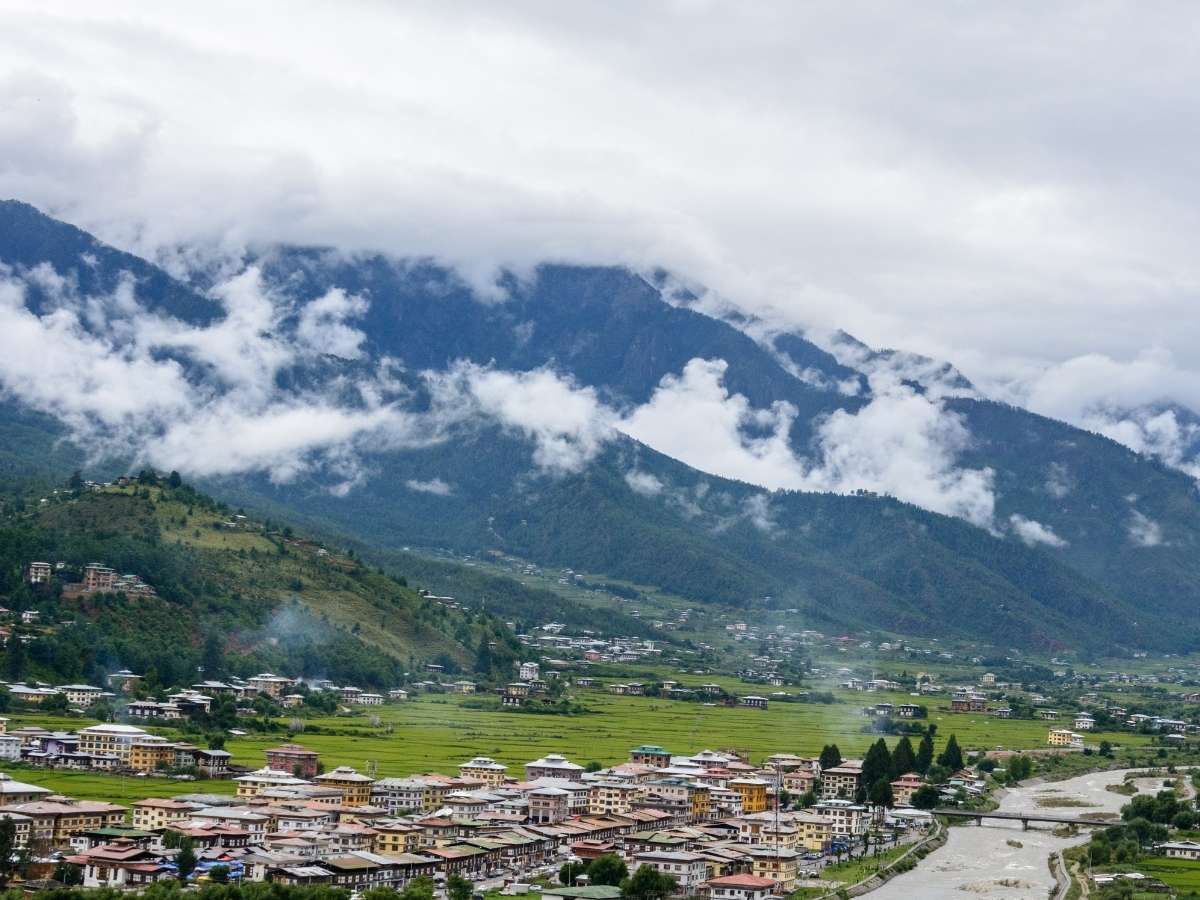
Bhutan is the only country in the world that measures its progress through Gross National Happiness rather than GDP. It is also carbon-negative, with vast forests soaking up more emissions than the country produces. These are not slogans. They shape how Bhutan welcomes visitors. A daily Sustainable Development Fee, set by the Bhutanese government, funds healthcare, schooling, and conservation, and the rule that foreign tourists must book through a licensed operator keeps numbers low and standards high.
The upshot is simple. You will not be racing other tour buses through a packed schedule. You will be travelling slowly, by design, with a guide who has known these valleys all their life. Trying to cram the country into a long weekend goes against the grain of how Bhutan actually works.
A first-time visitor often arrives expecting another Himalayan kingdom and leaves describing somewhere closer to a living museum. Television only reached Bhutan in 1999. The national dress, the gho for men and the kira for women, is still worn daily by most Bhutanese people, not as costume but as ordinary clothing. Even the architecture follows a code: every building, from the smallest village home to the grandest hotel, must be built in the traditional style, with painted timber lintels and small, deep-set windows. The whole country, in other words, has chosen its own pace. A thoughtful itinerary leans into that choice rather than fighting it.
The Geography That Shapes Your Days in Bhutan
Almost every Bhutan trip follows the same single road. It runs east to west through a string of mountain valleys, and the further along it you travel, the fewer visitors you meet.
The Western Loop: Paro, Thimphu, and Punakha Destinations
The classic loop sits in the west. You fly into Paro, drive an hour to Thimphu, the capital of Bhutan, cross the Dochula Pass to Punakha, and at some point you turn around. These three valleys hold most of the country’s famous sights, including the Tiger’s Nest Monastery, and the altitudes are gentle enough for a first-time traveller. They also give you a useful window into rural Bhutan, since even the capital still feels like a country town.
Distances on a map look small. Punakha is only about 75 kilometres from Thimphu. But the road climbs to 3,100 metres at Dochula Pass and twists through pine forest the whole way, so the drive takes three hours on a good day. Plan for the road, not the distance. The same rule applies elsewhere. A 120-kilometre hop east can swallow a whole day, and the drive itself becomes part of the experience rather than a transfer to be endured. Most travellers find that two nights in each valley is the sweet spot, giving one full day for sightseeing and one for slower exploration on foot. For a broader look at what to prioritise across the country, our guide to landmarks, valleys and culture in Bhutan covers the key experiences in more depth.
The Journey Further East: Phobjikha and Bumthang
Beyond Punakha, the road keeps climbing. The Phobjikha Valley opens up as a wide glacial bowl where black-necked cranes spend the winter, and a long day’s drive further on you reach Bumthang, the spiritual heartland of the country. This is where competitor itineraries usually stop short.
Going further east is the single biggest upgrade you can make to a Bhutan trip. You trade a day of driving for valleys most visitors never see, monasteries founded in the seventh century, and farmhouses that still serve buckwheat pancakes and red rice grown in the fields outside. The pace shifts noticeably the further east you travel. Roads narrow, transportation thins to the odd local pick-up truck, and the call of a yak bell can replace the sound of a car engine for hours at a stretch. For travellers who want the real measure of their days in Bhutan, this stretch is where the country opens up.
A Classic Bhutan Itinerary for 7 Days
A Bhutan itinerary for 7 days is the shortest sensible visit. This seven day Bhutan itinerary covers the western loop, gives you time on the Tiger’s Nest hike, and leaves a buffer for jet lag. It will not get you to Bumthang, and Phobjikha will feel rushed. Treat seven days as the minimum, not the ideal.
Here is what a balanced week looks like.
Days 1–2: Arrival in Paro and on to Thimphu
The flight into Paro is part of the experience. Druk Air and Bhutan Airlines are the only carriers, and most UK travellers route through Delhi, Kathmandu, or Bangkok. The descent into Paro airport is famously dramatic, with the plane banking between green hills before touching down on a single short runway. Only a handful of pilots in the world are certified to fly it.
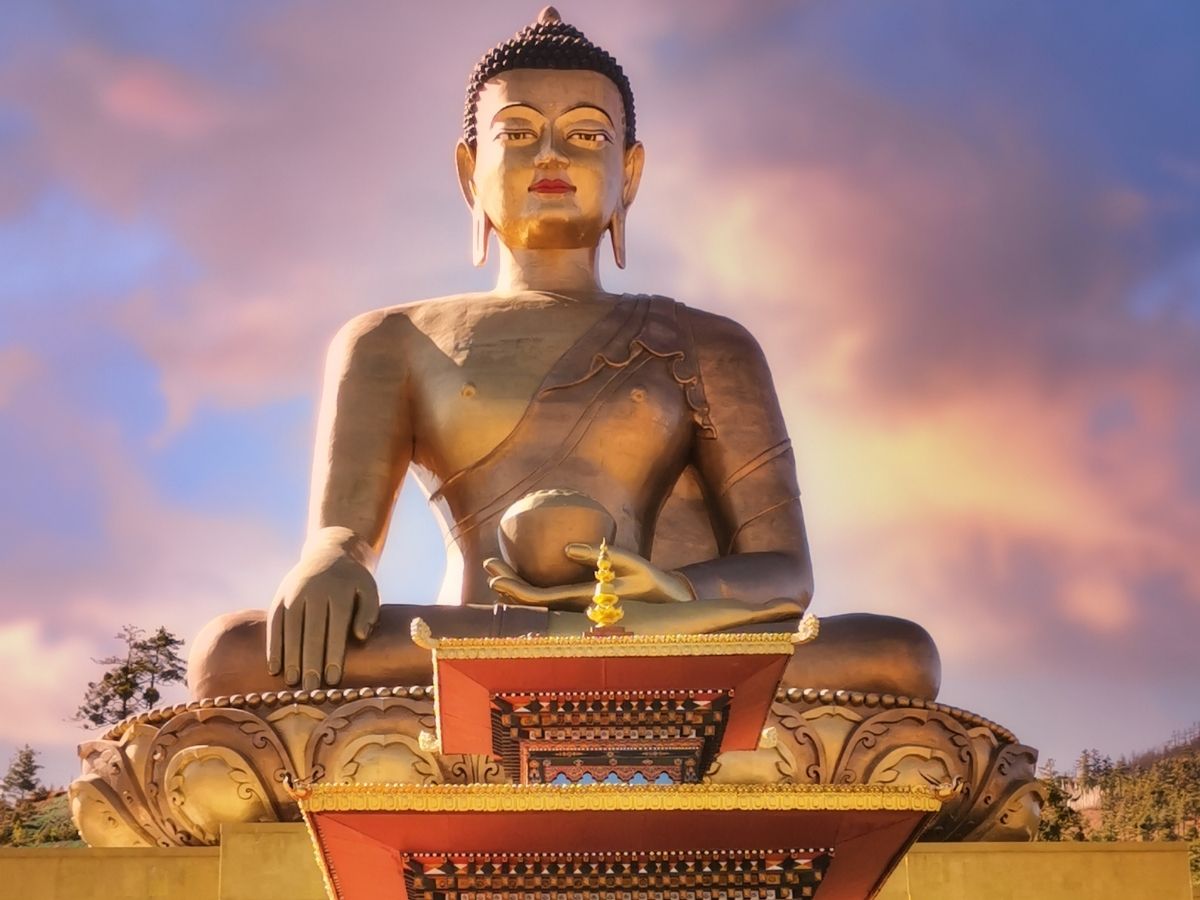
Spend the first afternoon gently. Paro sits at around 2,200 metres, so a slow visit to Ta Dzong, the round watchtower that now houses the national museum, and the imposing Paro Dzong (also known as Rinpung Dzong) below it is enough. Kyichu Lhakhang, just outside Paro town, is one of the oldest examples of a Buddhist temple in the country and a calm place to begin. The next day, drive an hour to Thimphu, the world’s only capital with no traffic lights. The Tashichho Dzong, the giant Buddha Dordenma statue at Buddha Point on the hill above the Bhutanese capital, and the weekend farmers’ market give you a fast read on how the country lives. Stop briefly at the Motithang Takin Preserve too, where the curious goat-antelopes that serve as Bhutan’s national animal graze in a forest enclosure on the city’s edge.
Days 3–4: Thimphu to Punakha and the Punakha Dzong
The drive from Thimphu to Punakha crosses Dochula Pass, where 108 small chortens stand against the sky and, on a clear morning, the Himalayan mountains line up behind them. Stop for tea at the café, take the photographs, and let the altitude settle.
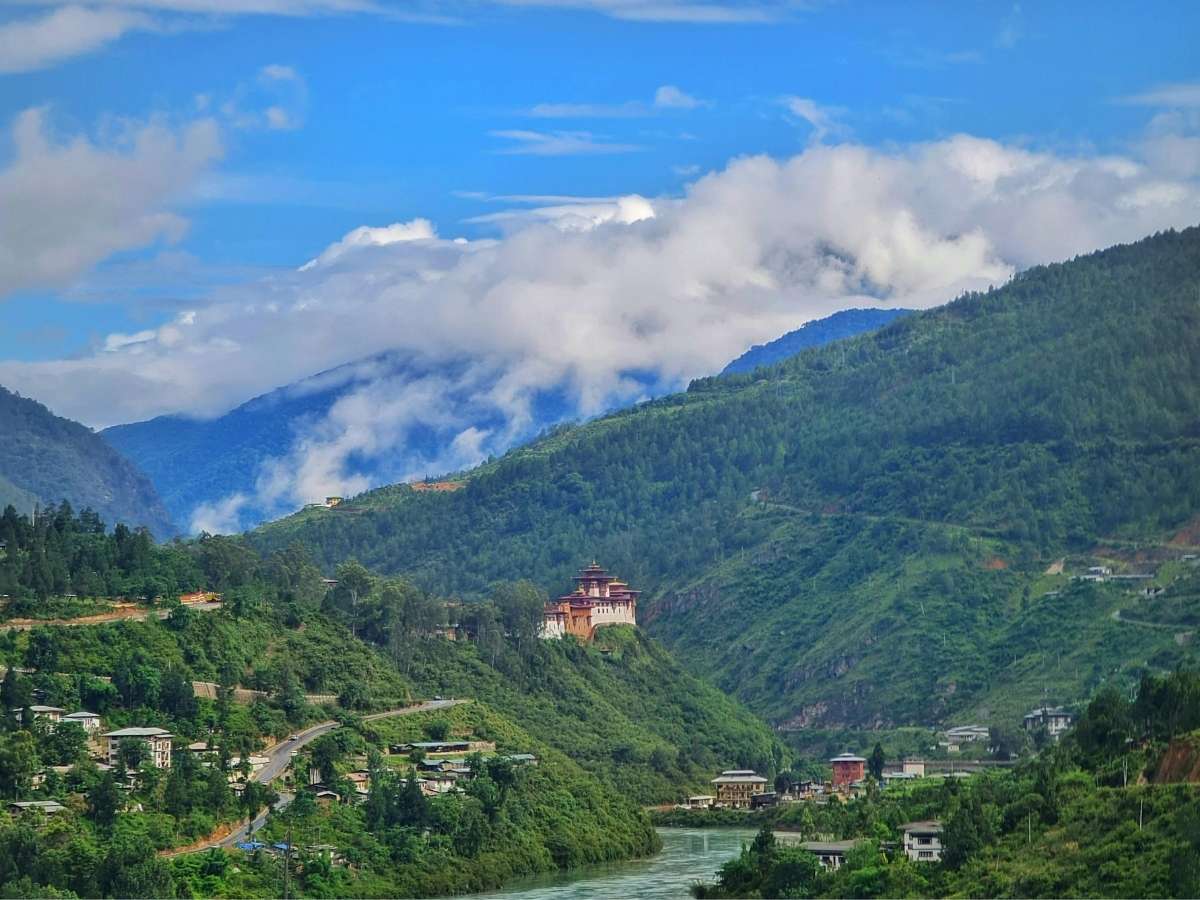
The Punakha valley lies much lower, at about 1,250 metres, where the climate turns warm and rice grows in terraces along the river. The Punakha Dzong, set at the meeting of the Mo Chu and Pho Chu rivers, is the most beautiful in the country. It was the seat of government until 1955 and still hosts the kingdom’s most important ceremonies. Cross the long suspension bridge over the Pho Chu for the iconic photograph, with prayer flags rippling above the turquoise water. Chimi Lhakhang, the fertility temple founded by the wandering monk known as the Divine Madman, sits on a small hill above the rice fields and makes a gentle afternoon walk. A second day in Punakha gives time for the climb to Khamsum Yulley Namgyal Chorten, a three-storey stupa on a ridge with sweeping views over the valley.
Days 5–6: Phobjikha Valley, Gangtey Monastery and the Nature Trail
A morning’s drive from Punakha brings you to the Phobjikha Valley, a wide U-shaped glacial valley that feels remote even by Bhutanese standards. Gangtey Monastery looks out from a low hill, and the short Gangtey nature trail loops through pine and bamboo down to the valley floor. The trail is gentle, around five kilometres in total, and ends at a small village where horses graze in the open pasture.
From November to February, the valley fills with black-necked cranes flying down from the Tibetan plateau. They are sacred birds in Bhutan, and even the local power lines have been laid underground to protect them. The annual Black Necked Crane Festival in November pairs traditional mask dances with conservation messages and is one of the more unusual things you can witness in Bhutan. Spending two nights here lets you see the valley at both ends of the day, when the light is softest and the cranes are most active.
Day 7: the Tiger’s Nest Monastery Hike
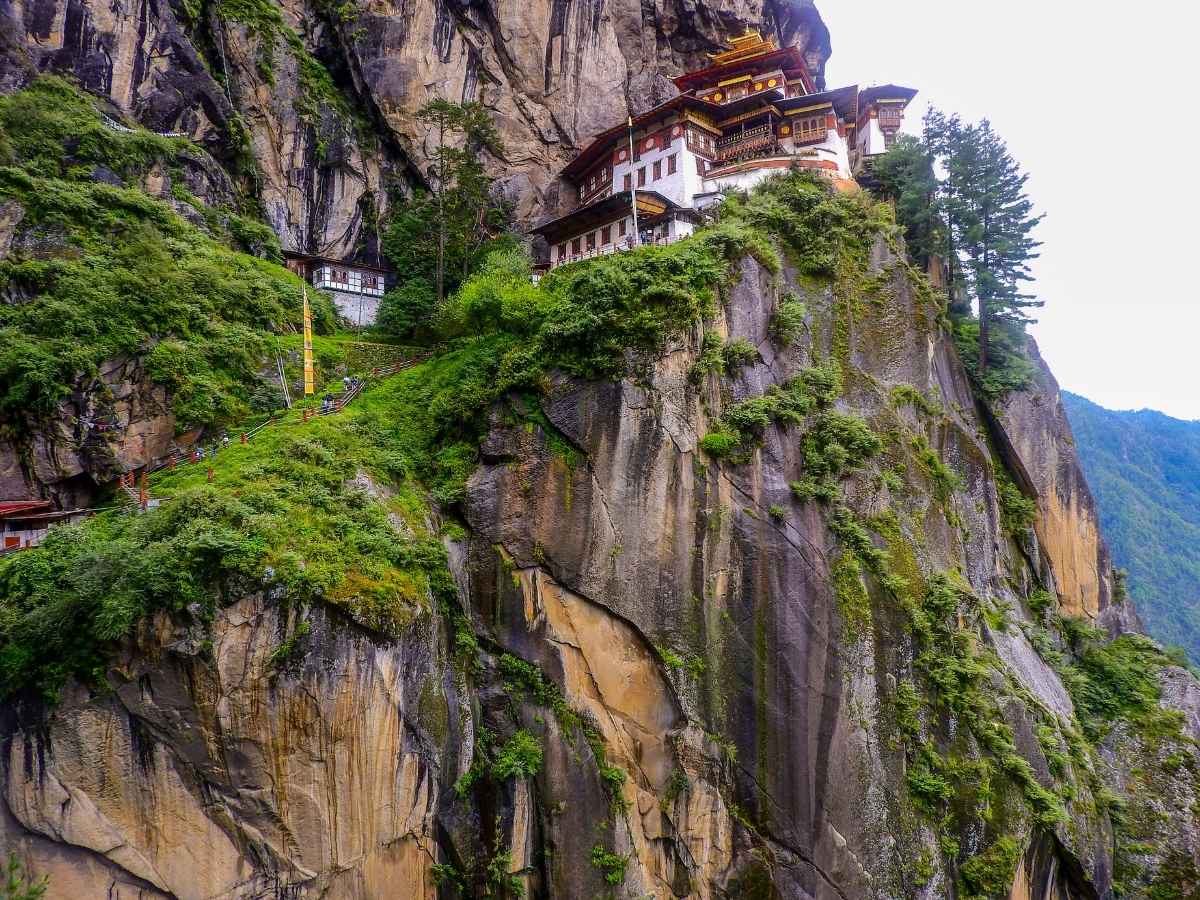
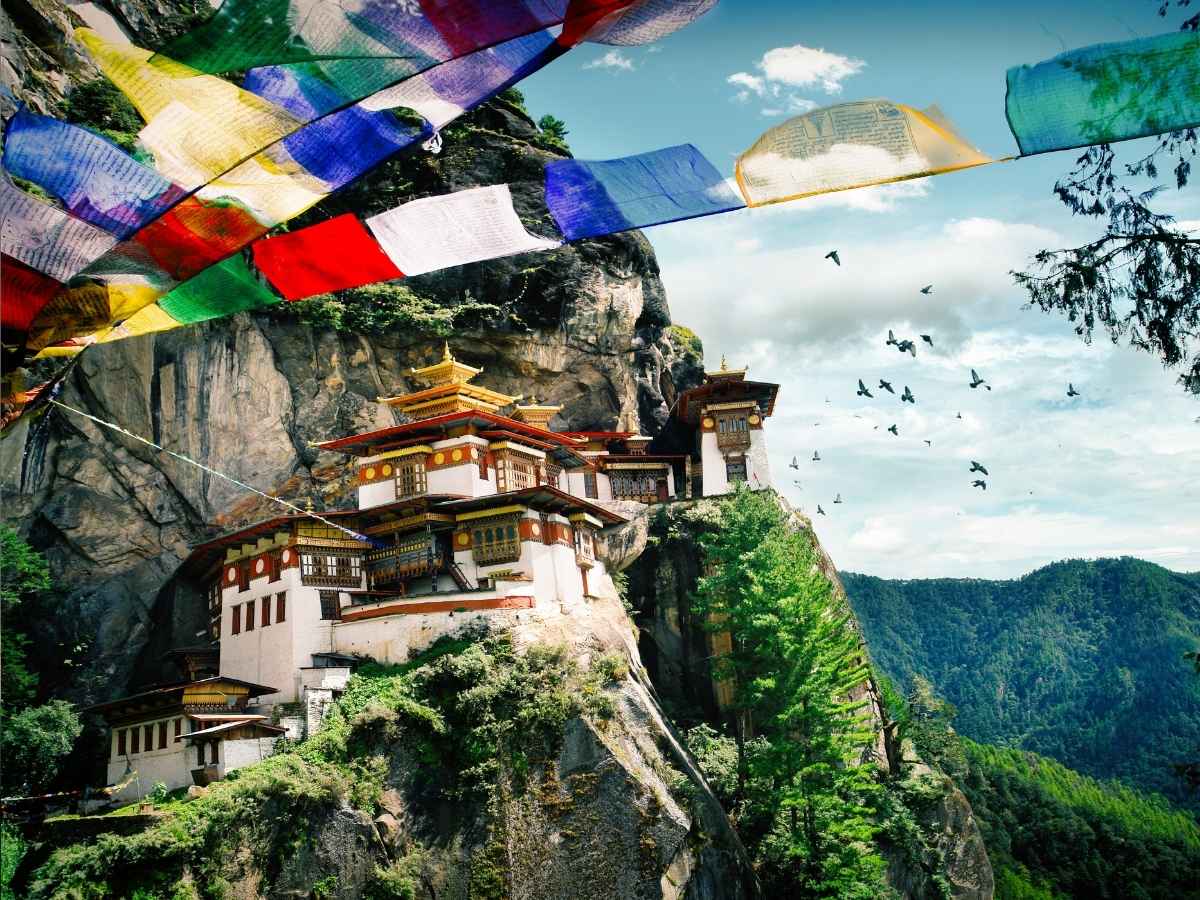
The trip ends back where it started. Drive to Paro and turn straight uphill towards the Taktsang Monastery, better known as the Tiger’s Nest. The hike climbs about 900 metres in roughly four hours of total walking, and the monastery itself clings to a cliff that hardly looks real. There is a cafeteria roughly halfway up, with a viewing terrace that gives the first proper look at the monastery across the gorge. Saving this hike for the last day is not an accident. By now your body has settled into the altitude, and the climb feels like the right ending rather than a heavy start. Round off the day with a traditional hot stone bath, in which river stones are heated over a fire and dropped into a wooden tub of herb-infused water. After the climb, it is the perfect way to close the trip.
Travellers with a little more time can add other day hikes around Paro and Thimphu, or for the genuinely fit, take on the four-to-five-day Druk Path trek between the two valleys. The route climbs to around 4,200 metres, camps beside high alpine lakes, and rewards walkers with some of the finest Himalayan views in the country.
Going Beyond the Standard Tour — Adding Bumthang and the East
Stretching a trip to ten or thirteen days unlocks a different Bhutan. The roads quieten, the valleys narrow, and the tour groups thin out almost entirely.
The Bumthang Valley
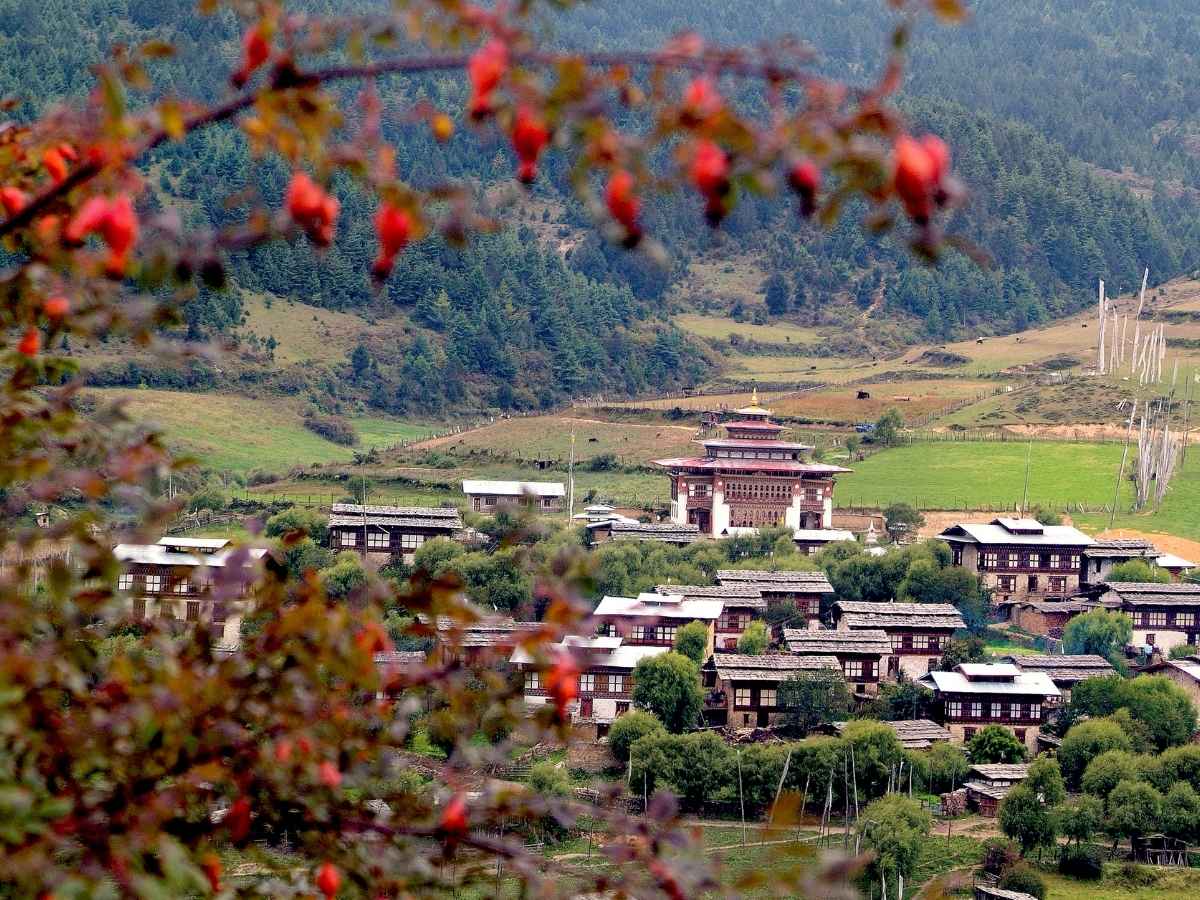
Bumthang is really four valleys in one, set at around 2,600 metres in central Bhutan. It is the country’s religious cradle. Jambay Lhakhang dates from the seventh century, built in a single night, according to legend, as part of a chain of 108 temples constructed by the Tibetan king Songtsen Gampo. Kurjey Lhakhang holds the cave where Guru Rinpoche meditated and is said to have left an imprint of his body in the rock. Jakar Dzong watches over the town from a ridge above.
The food shifts here too. Buckwheat pancakes, yak cheese, and apple wine appear on the menu, and a farmhouse dinner of ema datshi (chillies cooked in cheese sauce) tastes earthier when the chillies grew on the hillside outside. Bumthang is also home to the country’s only operating brewery and a small cheese factory founded by a Swiss aid worker in the 1960s, both of which welcome visitors. A relaxed day trip walking between the valley’s main temples, with a stop for cheese and apple wine in between, is the kind of slow day itinerary that defines a longer Bhutan trip — and one that fits naturally into our Bhutan festival small group tour, which takes in Bumthang’s most celebrated ceremonies.
Trongsa Dzong and the road east
To reach Bumthang from Punakha, you drive through Trongsa, home to the longest dzong in Bhutan and the ancestral seat of the royal family. The road itself is the experience: a slow ribbon of switchbacks through cloud forest, past prayer flags that mark every high pass. The Ta Dzong watchtower above Trongsa now houses an excellent museum of the monarchy, well worth an hour on the way through. The drive between Trongsa and Bumthang crosses the Yotong La pass at 3,425 metres, often blanketed in mist, before dropping into the open pastures of the Chumey valley.
Combining Bhutan with Nepal
For travellers with more time, pairing Bhutan with Nepal is the natural next step. The Kathmandu to Paro flight is one of the great short-haul journeys in the world, with Mount Everest, Kanchenjunga, and the rest of the Himalayan giants lined up out of the left-hand windows. A combined trip lets you bookend the Bhutanese festivals with Kathmandu’s UNESCO temples, Chitwan’s jungle wildlife, and the lakeside calm of Pokhara — our Nepal and Bhutan combined tour is designed exactly around this pairing. Adding Nepal also gives travellers a useful contrast: the noise and colour of Kathmandu’s old town set against the hush of a Bhutanese hill town makes both halves of the trip feel richer.
When to Visit Bhutan for the Best Itinerary
Bhutan has four very different seasons, and your choice affects almost everything: visibility of the mountains, festival timing, trail conditions, and how warm you will be in a farmhouse. A full breakdown of each season’s strengths and drawbacks is in our Bhutan season-by-season guide, but here is the shape of the year.
Spring runs from March to May. The valleys fill with rhododendrons and magnolias, the air is clear, and the Paro Tshechu in early spring is one of the most attended festivals of the year. Temperatures in the western valleys sit comfortably between 10 and 20 degrees Celsius, and the long Himalayan views from passes like Dochula are at their sharpest after a good morning frost.
Autumn, from late September to November, is the busiest season. Skies are at their sharpest, mountain views are reliable, and several of the biggest festivals fall in this window. Book early. Daytime temperatures stay pleasant, but nights at altitude drop sharply, so layering matters.
Winter, from December to February, brings cold but crisp days in the lower valleys. Phobjikha is the standout, with the black-necked cranes at peak numbers. Higher routes east can be closed, so this season favours the classic western loop. Hotel prices ease a little, and the few tourists you do meet tend to be the most curious about the country.
Summer, from June to August, is the monsoon. Rain shrouds the high passes, leeches appear on lower trails, and clouds often hide the mountains. The trade-off is empty trails, lush valleys, and the cheapest flights into the region. Garden lovers do well in summer, when wildflowers fill the meadows of the Phobjikha and Bumthang valleys.
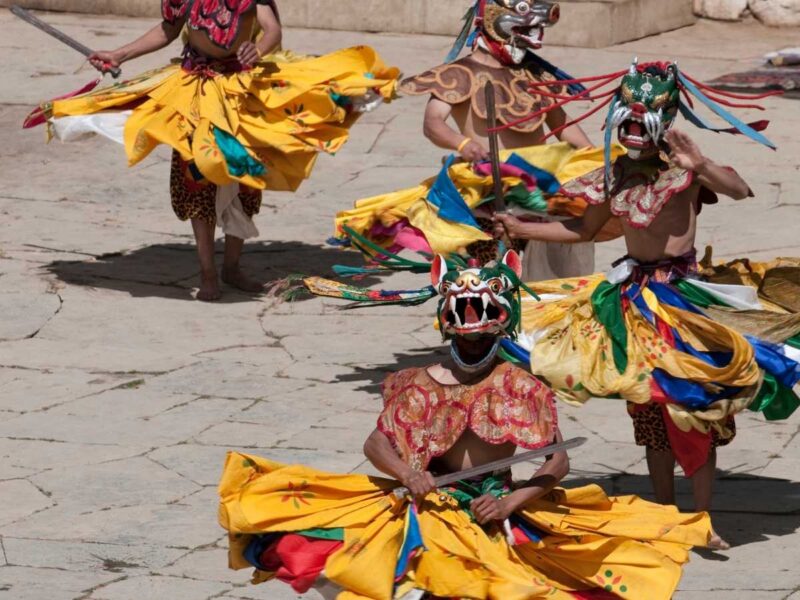
Festivals — the Heart of a Bhutan Itinerary
A Tshechu is a religious festival held in honour of Guru Rinpoche. Monks and laymen perform masked dances that tell stories from the Buddhist tradition, and locals come dressed in their finest gho and kira to watch, picnic, and pray. There is no other event quite like it in the Himalayas. Some dances last a few minutes, others go on for half an hour, and each one carries a story that has been passed down for centuries.
The big-name festivals are Paro Tshechu in spring and Thimphu Tshechu in autumn, both of which can draw thousands of visitors. The Punakha Drubchen in February re-enacts a seventeenth-century battle against Tibetan invaders, with men dressed as warriors charging through the dzong courtyard. Smaller festivals such as Nalakhar and Petsheling in Bumthang are more intimate, with fewer cameras and a closer view of the dancers. The Black Necked Crane Festival in Phobjikha is held each November and ties festival traditions to conservation work.
Planning a trip around a festival reshapes everything, and it is worth doing. Dates shift each year against the lunar calendar, so confirm them early. Festivals often unfold over three or four days, and even one full day inside a dzong courtyard while the dances play out is the kind of memory that defines the whole trip.
Practical Planning — Visas, Fees, and Getting There
A Bhutan tourist visa is issued through your licensed tour operator, not at the airport. You provide passport details, the operator handles the paperwork, and the visa is stamped on arrival in Paro. There is no walk-up route. Among the most useful Bhutan travel tips for first-timers: book at least four to six months ahead, since both flight slots and good guides fill up quickly around festival dates.
The Sustainable Development Fee is charged per person, per night, and is paid alongside your tour cost. The fee funds free healthcare and education for Bhutanese citizens, conservation projects, and infrastructure in remote valleys. Rates have changed in recent years, so check the current figure when you book.
UK travellers usually fly via Delhi, Kathmandu, or Bangkok, where they pick up Druk Air or Bhutan Airlines for the final leg to Paro. There are no direct flights from the UK. Most travellers spend a night in their connecting city on the way out, both to break the journey and to make sure the Paro flight is not at risk if the long-haul leg runs late. A typical day on a guided tour follows a gentle rhythm: breakfast at the hotel, a morning sight, lunch in a local restaurant, an afternoon walk or temple visit, and dinner back at the hotel.
Solo travellers do particularly well in Bhutan. Small group tours are common, group sizes are kept low, and good operators run trips without compulsory single supplements so you are not penalised for travelling alone. A guided itinerary also takes care of the licensing rule, the visa, and the daily fee in a single booking — our Bhutan cultural tour for women is a popular choice for solo female travellers looking for that security alongside a small, like-minded group. For travellers who like the security of a fixed plan but the warmth of a small group, Bhutan is one of the easiest countries in Asia to organise.
A final thought
Bhutan does not reward a packed itinerary. It rewards travellers who give it time — to walk uphill to a cliffside monastery, to sit in a dzong courtyard while monks chant, to share butter tea with a farmer at the end of a long valley. A week will show you the highlights. Ten days will let you breathe between them. Thirteen days will take you to Bumthang and the festivals that bring the whole country together.
Whatever shape your trip takes, the rule is the same: leave room for the moments you didn’t plan. Bhutan tends to provide them.
Ready to swap the highlight reel for the real thing? Speak to one of Undiscovered Destinations’ Bhutan specialists about a small group tour that puts you in the middle of a Tshechu festival, not just watching from the edge.