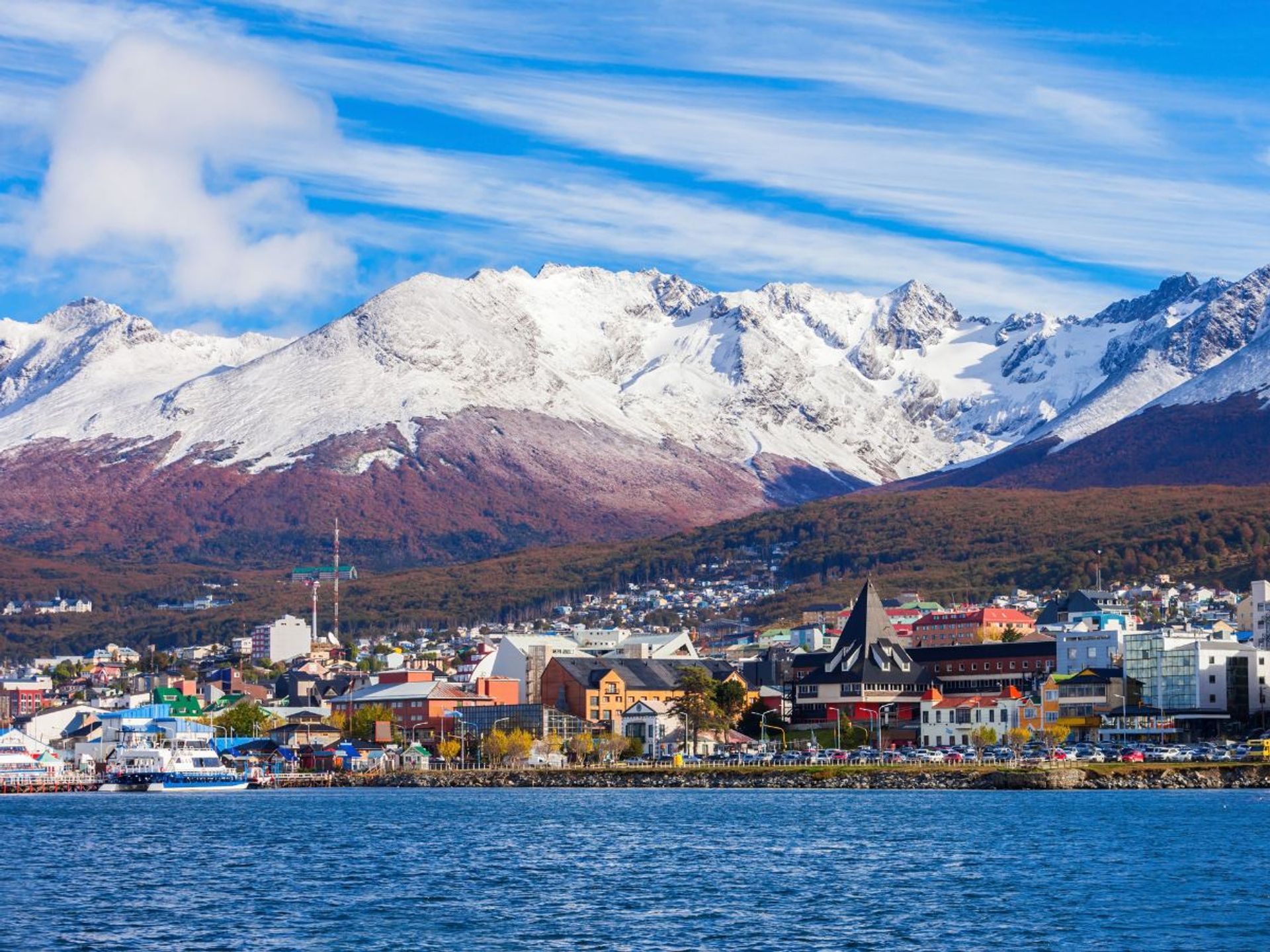

Perched on the edge of the Beagle Channel, Ushuaia is not a place you pass through by accident. It sits at the very tip of South America, further south than almost anywhere else people call home, and it wears that title with pride. This look at things to do in Ushuaia, Argentina starts with the obvious question: why come so far? Locals call it Fin del Mundo, the end of the world, and once you arrive, it is easy to see why. Snow-capped peaks rise straight out of the water, ships bound for Antarctica sit in the harbour, and the air carries a chill that never fully leaves, even in summer.
Ushuaia in Argentina rewards travellers who come with time to explore. Between the national park on its doorstep, the wildlife-rich waters of the Beagle Channel, and a history shaped by convicts, sailors and explorers, there is far more here than a quick photo at a signpost. Add in its role as a launch point for the far south, a duty-free shopping scene, and a food culture built around king crab and lamb, and a short stopover can easily stretch into several rewarding days. Even travellers who arrive expecting little more than a stamp in their passport on the way to Antarctica often leave having spent far longer in the town than they originally planned. This Ushuaia travel guide walks through what makes the town worth the journey on a first visit or a fifth, from its dramatic landscapes to the practical details of getting there.
Getting to Know Ushuaia, Argentina's End of the World
Ushuaia was founded on 12 October 1884, built on a wide bay along the southern coast of Isla Grande de Tierra del Fuego. It grew slowly at first, shaped by fishing, sheep farming and a notorious prison, before tourism transformed it into the gateway city it is today. Ships now leave its port for Antarctica, and the town itself has become a destination in its own right rather than simply a stop on the way somewhere else.
What makes Ushuaia, Argentina so distinctive is its setting. The Beagle Channel stretches out in front of the town, separating Argentina from Chile, while the Martial mountain range rises steeply behind it. Few cities anywhere sit so close to genuine wilderness. Walk ten minutes from the centre and you are already in forest, with condors overhead and glaciers visible in the distance. The town itself is compact and easy to explore on foot, with most hotels, restaurants and tour offices clustered along two main streets that run parallel to the water.
There is also a strong sense of remoteness that shapes daily life here. Supplies still travel long distances to reach the shops, and the surrounding wilderness is never far from view, even from the centre of town. That combination of accessibility and isolation is part of what draws so many travellers south in the first place.
Why It's Called the Beagle Channel
The channel takes its name from HMS Beagle, the British Royal Navy ship that carried out a hydrographic survey of the southern coasts of South America between 1826 and 1836. Robert FitzRoy captained the second of these voyages, bringing along a young naturalist named Charles Darwin as a companion. Darwin recorded his first sight of glaciers as the Beagle sailed through the channel in the 1830s, describing them in his notebook as "beryl blue" against the snow. FitzRoy later named a nearby peak Mount Darwin in honour of his companion's twenty-fifth birthday, a small but lasting mark left on the map by two men who never intended to become so closely tied to this part of the world.
How to Travel to Ushuaia, Argentina
Most visitors arrive by air. Flights from Buenos Aires take around three and a half hours, cutting straight down the length of the country and offering striking views of the Andes and the southern coastline as the plane descends. See our Buenos Aires city guide if you're spending time in the capital first. Several airlines run this route daily, making it the simplest way to reach the region, and the airport itself sits close enough to town that transfers rarely take more than fifteen minutes.
Overland Through Patagonia
For those already exploring Patagonia, travelling to Ushuaia by road is a genuine adventure in itself. Long-distance buses run south from towns such as El Calafate and El Chaltén, crossing briefly into Chile before re-entering Argentina in Tierra del Fuego. The full journey takes roughly twelve to eighteen hours and includes a ferry crossing of the Magellan Strait, so it suits travellers who see the transfer as part of the experience rather than a chore to get through quickly. Along the way, the landscape shifts from the dry steppe of southern Argentina to the forested hills and channels that surround Ushuaia itself, making the final approach feel like a genuine arrival rather than just another airport transfer, one of many interesting facts about Patagonia that make the overland route worthwhile.
Combining Ushuaia with the Rest of Patagonia
Many visitors choose to pair Ushuaia with other highlights further north, such as the Perito Moreno Glacier near El Calafate or the granite peaks of Fitz Roy near El Chaltén. Some itineraries also cross briefly into Chile to take in Torres del Paine National Park, with its dramatic granite towers, before returning to Argentina for the final leg south. Doing so by road or a mix of short domestic flights and buses turns a single-destination trip into a broader journey through some of the most dramatic scenery in South America, with Ushuaia serving as a fitting final stop before heading home or on to Antarctica. Travellers who plan their route this way often find that the changing landscape, from wide open steppe to glaciers to the forested channels around Ushuaia, tells its own story about just how varied Patagonia can be within a relatively small stretch of the map — one of many reasons the region features so often on lists of the intresting places to visit in Argentina.
Ushuaia as the Gateway to Antarctica
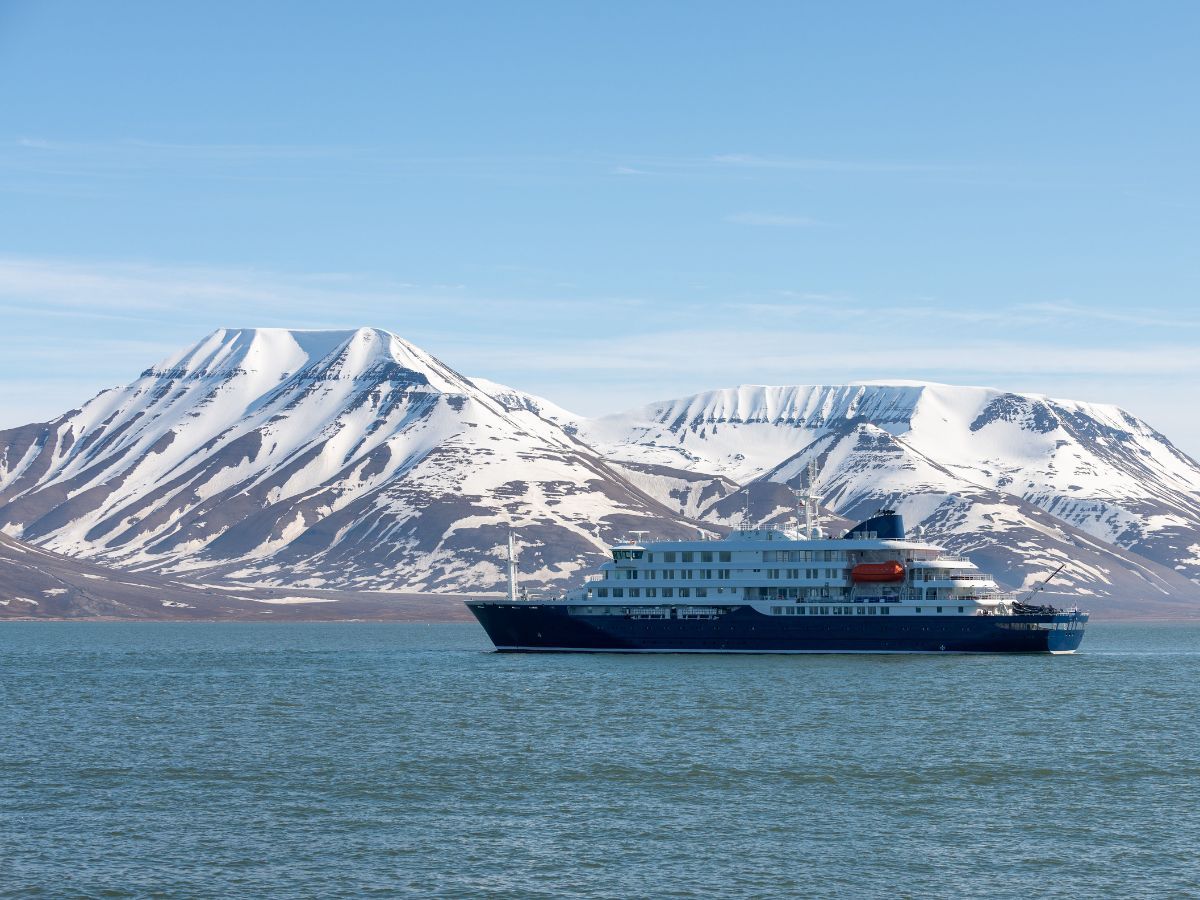
For many travellers, Ushuaia is best known not for what it offers on its own, but for where it leads. As the world's southernmost cruise port, it serves as the principal embarkation point for expedition ships heading to Antarctica. The cruising season generally runs from November through to March, when ice-class vessels depart from the harbour for a Drake Passage crossing that typically takes between forty-eight and seventy-two hours.
Even travellers with no plans to continue south can feel the pull of this connection. Watching an expedition ship prepare to leave, its hull painted for polar ice rather than tropical waters, is a reminder of just how far Ushuaia sits from anywhere else. Early in the season, November sailings tend to catch penguins in the middle of their courting rituals, while by January the days lengthen further still and temperatures on the peninsula climb close to their yearly high. Later in the season, February and March bring dramatic glacier calving and some of the best whale sightings of the year, though advancing ice can occasionally limit access to certain landing sites further south. Visitors who do not plan to sail south themselves can still get a taste of the Antarctic connection by visiting the harbour at Muelle Turístico, where expedition ships dock before and after their voyages, or by learning more about the region's polar history at the town's museums.
The scale of the crossing itself is part of what makes Ushuaia's role so significant. The Drake Passage, the stretch of open ocean between Cape Horn and the Antarctic Peninsula, has a reputation as one of the roughest crossings in the world, and the fact that ships can reach it after only a short sail from a functioning town, rather than after days at sea, is a large part of why Ushuaia became the obvious launch point for polar tourism in the first place.
Exploring Tierra del Fuego National Park
Tierra del Fuego National Park was created in 1960 to protect the region's forests, mountains and coastline, and it remains one of the best reasons to visit Ushuaia. Only a portion of its total area, around 5,000 acres, is open to the public, but that section alone combines Sub-Antarctic forest, Andean peaks and the marine environment of the Beagle Channel within a single afternoon's walk.
Trails and Viewpoints
The park's trails suit a wide range of fitness levels. Shorter paths wind through the woods to Lake Roca, a glacial lake that changes colour with the weather, from deep blue under clear skies to a flat pewter grey when clouds roll in. Longer routes lead to Lapataia Bay, where a wooden sign marks the southern end of Argentina's National Route 3, often called the end of the Pan-American Highway. Along the way, keep an eye out for beavers, introduced decades ago and now a permanent, if controversial, feature of the landscape, along with foxes and, if you are fortunate, the occasional condor riding the thermals above the tree line.
The Tren del Fin del Mundo (End of the World Train)
For a gentler introduction to the park, a narrow-gauge steam train, known locally as the Tren del Fin del Mundo, follows part of the old route once used by prisoners sent into the forest to cut timber. It winds through peat bogs and past waterfalls before reaching the edge of the park itself, offering a scenic and fairly effortless way to see the landscape for travellers who would rather sit back than hike. Most trips finish with a short walk to a viewpoint, giving even less mobile visitors a proper look at the surrounding mountains and channel.
Wildlife Encounters on the Beagle Channel
A boat trip on the Beagle Channel is, for many visitors, the highlight of an Ushuaia trip. Setting off from the harbour, boats trace the same waters once used by explorers heading south, passing close to small rocky islands thick with wildlife.
Birds and Sea Lions
The first stop on most cruises is Bird Island, home to cormorants, skuas and gulls nesting along the cliffs. From there, boats move on to Sea Lion Island, where colonies of southern sea lions and southern fur seals gather on the rocks, barking and jostling for space.
Martillo Island: A Walk with Penguins
Further along the channel, some tours continue to Martillo Island, known locally as Isla Martillo, one of the few spots in the region where Magellanic penguins nest close enough for visitors to walk among them on land, alongside occasional sightings of the larger, more distinctive king penguin. Unlike the boat-only viewing at Bird Island and Sea Lion Island, landings on Martillo Island are limited to small groups at a time, so operators tend to book them well in advance during the busiest summer weeks.
Les Eclaireurs Lighthouse
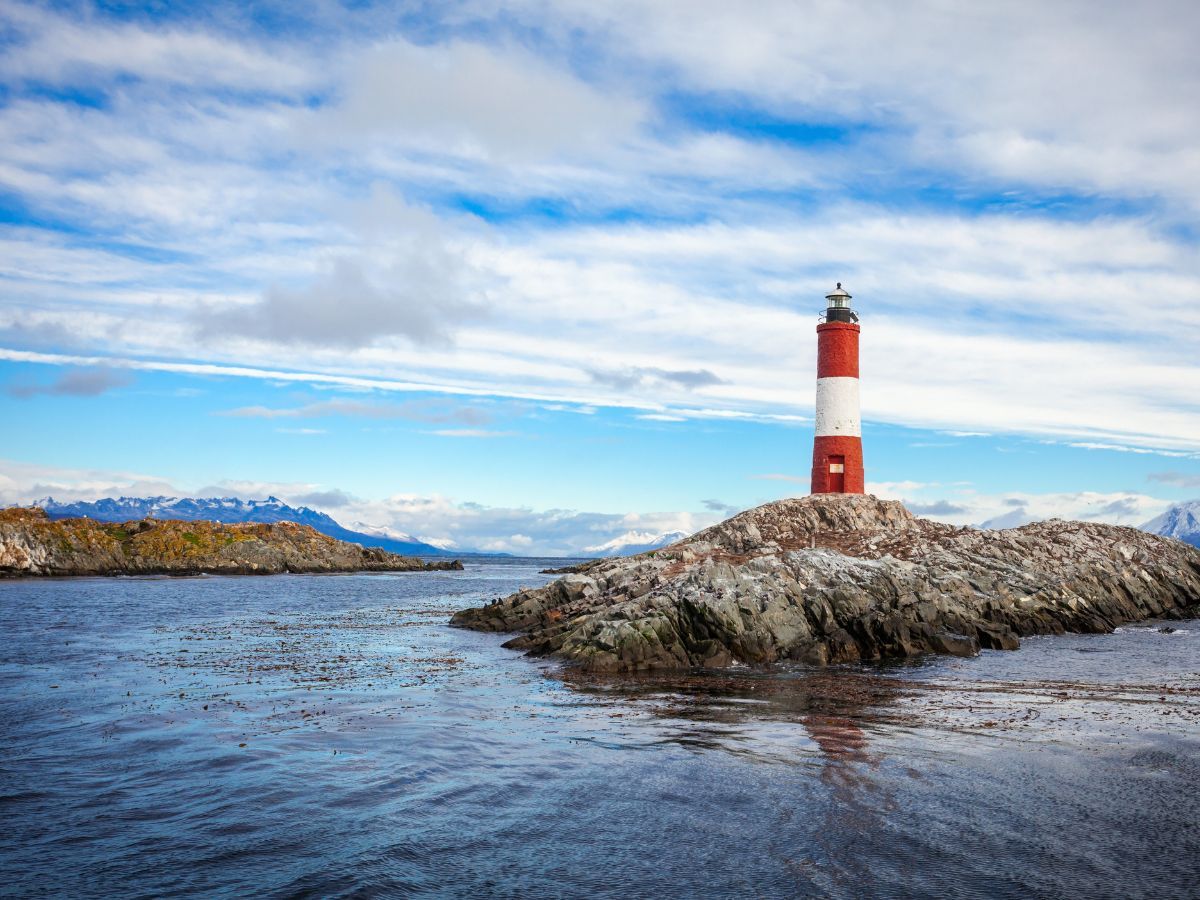
Perhaps the most photographed sight on the water is the Les Eclaireurs Lighthouse, a red-and-white tower standing on a small islet. It is frequently, and wrongly, called the End of the World Lighthouse, a title that actually belongs to a different structure further along the coast. The mix-up has stuck regardless, and the lighthouse remains one of the defining images of a Beagle Channel cruise.
Estancia Harberton and Whale Watching
Some longer cruises extend as far as Estancia Harberton, one of the oldest ranches in the region, where visitors can walk through gardens and historic buildings that offer a glimpse of what life was like for the first European settlers in this remote corner of the world. Travellers hoping to spot whales should time their visit between May and October, when southern right whales are most often seen in the channel and surrounding waters, a slower and quieter counterpoint to the lively wildlife of summer.
History and Culture in Ushuaia
The Presidio: Ushuaia's Prison Museum
Ushuaia's history is inseparable from its former prison, built largely by the inmates themselves starting in 1902 and operating until 1947, when it was permanently closed by presidential decree following reports of the harsh conditions inside. The building has since been converted into a museum, which opened to the public in 1997 and now covers maritime history, Antarctic exploration and the prison itself, with entire wings dedicated to model ships, polar expedition memorabilia and the daily routines of the inmates who once lived there, giving visitors a genuinely unusual look at how the town developed.
Civic Plaza and the Malvinas Memorial
The town also holds difficult, more recent history. A memorial in the centre, close to the Civic Plaza, commemorates the Malvinas conflict of 1982, in which more than 900 Argentine servicemen lost their lives, including 323 who died when the ARA General Belgrano was sunk. It is a sober counterpoint to the town's adventure-tourism image, and worth pausing at even briefly, particularly for visitors keen to understand more about the country's more recent past rather than only its colonial or indigenous history, a theme our Argentina culture guide explores further.
Iglesia de la Merced and a Paseo Along the Costanera
For something gentler, the Iglesia de la Merced holds the title of the world's most southerly Catholic church. Built by convicts in the 1940s, its simple, brightly painted exterior stands out against the surrounding mountains, a small but memorable stop on a walk through town. Nearby, the Costanera, Ushuaia's waterfront avenue, is made for a slow paseo rather than a purposeful walk, with wide views across the Beagle Channel towards the mountains of Chile and an easy, unhurried pace that suits the end of a day spent exploring the town's museums and streets.
Adventure Activities Beyond the City
Beyond its wildlife and history, Ushuaia has become something of an adventure hub, with glaciers, lagoons and mountain passes all within reach of a day trip from town.
Martial Glacier: A Hike Above the City
The Martial Glacier sits within easy reach of town, roughly a twenty-minute drive from the centre, and offers a rewarding hike of around six kilometres with close to 500 metres of elevation gain, climbing from the forested base up to a rocky viewpoint with views back over the Beagle Channel and the town below.
Glaciar Vinciguerra: Ice Trekking
Further into the mountains, the trek to Glaciar Vinciguerra takes most of a day and leads walkers through forest and open valley before reaching a lagoon dotted with small icebergs beneath the glacier face itself. On some tours, and depending on conditions, it is even possible to walk briefly on the ice with the help of a local guide, a memorable addition for travellers who want a closer look at Patagonia's shrinking glaciers than a viewpoint alone can offer.
Laguna Esmeralda: A Glacial Lake Walk
Another popular full-day option is the walk to Laguna Esmeralda, a striking green lake fed by glacial meltwater. The trailhead sits around seventeen kilometres east of Ushuaia, and the route itself is a round trip of roughly nine kilometres, crossing boardwalks and open peat bog rather than steep climbs, which makes it a good choice for reasonably fit walkers who want a dramatic destination without a punishing ascent.
Skiing, Off-Road Tours and Estancia Life
In winter, the nearby Cerro Castor resort draws skiers and snowboarders from across South America, taking advantage of reliable snow at a latitude where few other ski resorts exist. Summer months bring off-road tours through the southern Andes, often finishing with a traditional asado cooked over an open fire at a forest refuge. Trips to Estancia Harberton, mentioned earlier for its wildlife access, also work well as a standalone half-day outing, adding a slower, more historical note to an otherwise adrenaline-filled itinerary.
A Day Trip to Tolhuin: Paso Garibaldi and Cabo San Pablo
For visitors with a full day to spare, the road northeast from Ushuaia towards the town of Tolhuin opens up an entirely different side of Tierra del Fuego, away from the Beagle Channel and into the island's interior.
Paso Garibaldi and the Lakes: Escondido and Fagnano
Around forty-six kilometres from Ushuaia, National Route 3 climbs to Paso Garibaldi, a mountain pass sitting at roughly 450 metres above sea level. A viewpoint at the top looks out over Lago Escondido, a small glacial lake tucked into a forested valley below, and the western tip of Lago Fagnano beyond it, a binational lake stretching around 100 kilometres into Chile and the largest in the province.
Cabo San Pablo and the Desdemona Shipwreck
Further towards the Atlantic coast, roughly eighty kilometres from Tolhuin, Cabo San Pablo is home to one of Tierra del Fuego's more unusual sights: the rusting hull of the Desdemona, a cargo ship that ran aground here on 9 September 1985 and was never recovered. Half buried in the sand and still bearing its name along the hull, the wreck has become a favourite stop for photographers and a striking reminder of just how exposed this stretch of coastline can be.
Where to Stay: Hotels in Ushuaia
Most hotels in Ushuaia cluster along or just above the waterfront, close enough to the Beagle Channel to offer views over the water and the mountains of Chile beyond. Small-group tours through the region often base themselves at hotels such as Los Acebos or the Canal de Beagle, both comfortable, mid-range properties within easy reach of the town centre, though standards and options vary widely depending on budget and season.
Booking ahead matters more than it might elsewhere in Argentina. Rooms fill quickly during the Antarctic cruise season between November and March, when the town's population swells with passengers arriving and departing between voyages, so it's worth cross-checking against the when to visit Argentina as you plan the wider trip, rather than arriving speculatively.
Shopping and Everyday Life in Ushuaia
Duty-Free Shopping
One detail that surprises many first-time visitors is that Ushuaia, along with the rest of Tierra del Fuego, is exempt from Argentina's standard value added tax. This duty-free status means that both local and imported goods, from electronics to perfume, are often sold more cheaply here than elsewhere in the country, and two dedicated duty-free shops, one in the town centre on Avenida San Martín and another at the airport, do a steady trade with travellers picking up last-minute purchases before flying home.
Restaurants and Local Food
Food is another highlight of daily life in the town. Restaurants along Avenida Maipú and Avenida San Martín serve centolla, the enormous local king crab, alongside Patagonian lamb roasted slowly over an open fire, and freshly caught fish pulled straight from the surrounding waters. Even a short stay in Ushuaia usually includes at least one meal built around these local specialities, and many visitors count a plate of king crab among the most memorable parts of their trip.
Practical Tips: Getting Around and Currency
Getting around the town itself is straightforward. The centre is compact enough to explore on foot, with most attractions, restaurants and tour operators within a short walk of the waterfront. Taxis and remises, a type of pre-booked local car service, also provide easy transport to the airport and nearby trailheads. The Argentine peso is the local currency, although many tour operators and larger shops accept card payments. It is still worth carrying some cash for smaller cafés and market stalls in case card machines are unavailable. For more on staying safe and prepared this far south, see our Argentina travel safety guide.
Planning Your Trip to Ushuaia: Best Time to Visit and How Long to Stay
Patagonia's weather rarely settles, and Ushuaia is no exception, which is why it's worth reading our guide to the best time to visit Patagonia before booking. The mean yearly temperature sits at around 2 degrees Celsius, with the coldest month, June, averaging close to 2.3 degrees and the warmest month, January, reaching an average of around 10.3 degrees. Even within those averages, conditions can shift through what feels like four seasons in a single day, so packing layers and rainwear matters more than checking a single forecast. Annual rainfall and snowfall together add up to roughly 1,031 millimetres, spread fairly evenly across the year, with most snow falling between April and November.
Summer, running from December to February, brings the longest days, with around sixteen and a half hours of daylight in January alone, giving visitors plenty of time to fit in a full day of hiking or a boat trip without racing the sunset. Travellers hoping to see whales should aim for the months between May and October instead, when southern right whales are most often spotted in the waters around Tierra del Fuego, even though the shorter, colder days mean fewer hours for exploring on land.
Most people manage to see the highlights of Ushuaia in two to three days, taking in the national park, a Beagle Channel cruise and a wander through the town's museums and streets. Anyone keen on longer hikes, glacier trekking or winter sports will want to build in extra time, since the surrounding wilderness rewards a slower pace far more than a rushed visit ever could. For travellers combining Ushuaia with the rest of Patagonia, allowing at least a week for the wider region gives enough time to properly enjoy both the glaciers further north and the channels and mountains around Ushuaia itself, without feeling as though any single stop has been rushed.
Conclusion
Ushuaia earns its nickname honestly. Few places combine wild coastline, genuine history and easy access to Antarctic waters in quite the same way, and few reward a slower, more curious visit as generously. Seeing it properly, rather than rushing through for a photo at the signpost, is what turns a stopover into a real highlight of any Patagonia trip.
Whether the draw is a boat trip past sea lions on the Beagle Channel, a plate of king crab after a day on the trails, or simply standing at the edge of a continent and looking south towards Antarctica, Ushuaia has a way of staying with visitors long after they have flown home. Few destinations manage to feel both genuinely remote and entirely welcoming at the same time, and that balance is worth experiencing in person rather than reading about from a distance.
If Ushuaia attraction has found its way onto your travel list, it makes sense as part of a wider journey through Patagonia's glaciers, peaks and channels rather than a stop on its own. Undiscovered Destinations builds small-group adventures through this part of the world, with no single traveller ever paying extra to explore it alone. Let the end of the world be where your next story begins.