Algeria: Highlights of the Roman Ruins
What this journey is about
Discover Algeria's extraordinary ancient heritage on this ten-day private journey through some of North Africa's most remarkable archaeological sites. From the Mediterranean coastline to the dramatic landscapes of the Aurès Mountains, this itinerary explores the legacy of the Numidian kingdoms, Roman Empire and early Christianity, alongside the fascinating cities and cultural traditions of modern Algeria.
Begin in the capital, Algiers, exploring its atmospheric UNESCO-listed Casbah, historic streets and fascinating Roman remains. Travel west along the Mediterranean coast to discover the magnificent archaeological sites of Tipasa and Cherchell, where ancient temples, theatres and villas reveal the importance of this region during Roman times.
Continue east to the extraordinary Roman ruins of Djemila, one of the best-preserved ancient cities in North Africa, before reaching Constantine, a spectacular city perched above deep gorges. From here, explore the lesser-known ruins of Tiddis, the remarkable Roman city of Timgad and the ancient military settlement of Lambaesis, gaining an insight into the sophisticated engineering, architecture and everyday life of the Roman world.
The final part of your journey takes you to Guelma and Annaba, where you will discover further archaeological treasures and explore the legacy of St Augustine at Hippo Regius. Combining UNESCO World Heritage Sites, impressive ancient monuments and fascinating historical cities, this journey offers an in-depth exploration of Algeria's rich and varied past.
Private Tour Departures: This itinerary can be arranged privately throughout the year, subject to availability. Domestic flights from Annaba to Algiers currently operate daily, allowing flexibility when selecting departure dates. However, the Museum of Antiquities in Algiers is closed on Sundays, so the sightseeing programme may need to be adjusted depending on your chosen dates. All flight schedules and arrangements will be reconfirmed at the time of booking.
Planned by Emma Holmes
Every tailor-made journey is shaped by a single UD specialist from first conversation to homecoming — the same person who plans your route is the one you speak to throughout.
A starting point
Everything below is a template — dates, pace, accommodation level and activities can all be tailored when you speak to your specialist. Tap any day to open it.
01Arrival in Algiers
Upon arrival at Algiers International Airport, you will be met by your local representative and transferred to your hotel in the city.
Algiers is a fascinating introduction to Algeria, a bustling Mediterranean capital where Ottoman palaces, French colonial architecture and modern Algerian life come together. Known as Algiers the White for its distinctive whitewashed buildings overlooking the bay, the city has a rich history stretching back thousands of years.
The remainder of the day is free to relax following your international journey or begin exploring your surroundings independently, depending on your arrival time.
02Historic Algiers, the Casbah and Roman Heritage
Today, enjoy a guided exploration of Algiers, discovering its fascinating history, atmospheric old town and ancient archaeological remains.
Begin with a short drive to the impressive Martyrs' Monument, an important landmark commemorating Algeria's struggle for independence. From here, enjoy panoramic views across the capital and its beautiful Mediterranean setting.
Continue into the city centre for a stroll along Didouche Mourad Street, one of Algiers' liveliest thoroughfares, lined with elegant colonial-era buildings, cafés and shops. Stop to admire the magnificent Grande Poste, an impressive example of early 20th-century architecture.
Your next stop is the legendary Casbah of Algiers, a UNESCO World Heritage Site and one of the finest surviving examples of a traditional North African medina.
Accompanied by your guide, explore its maze of narrow alleyways, passing centuries-old houses, traditional palaces and small local shops. As you descend through the old town, you will gain an insight into the city's Ottoman heritage and the everyday lives of its residents.
Continue towards Martyrs' Square, where archaeological excavations have revealed remains dating back to the Roman period. These discoveries provide a fascinating glimpse into the ancient settlement beneath the modern city.
Later, visit the Museum of Antiquities, home to an important collection of archaeological artefacts reflecting Algeria's diverse ancient civilisations.
Return to your hotel following the sightseeing.
Please note that the Museum of Antiquities is closed on Sundays, and the programme may need to be adjusted accordingly.
03Tipasa, Cherchell and the Mediterranean Coast
After breakfast, depart Algiers and travel west along the Mediterranean coast towards Tipasa, an area celebrated for its extraordinary archaeological heritage and beautiful coastal scenery.
En route, stop at the Royal Mausoleum of Mauretania, sometimes referred to as the Tomb of the Christian. Despite its name, this impressive Numidian monument predates Christianity and is believed to have been constructed during the ancient Mauretanian kingdom.
Continue to Tipasa, a UNESCO World Heritage Site containing some of Algeria's most evocative Roman remains. Situated beside the Mediterranean Sea, the archaeological site combines ancient monuments with spectacular coastal views.
Explore the remains of Roman villas, temples, public buildings and an ancient amphitheatre, gaining an insight into the importance of Tipasa as a trading centre and settlement during the Roman period.
Following your visit, continue along the coast to Cherchell, a picturesque town known in antiquity as Caesarea, once the capital of the Roman province of Mauretania Caesariensis.
Discover the remains of the ancient Roman theatre, basilica and baths, before visiting the archaeological museum, which houses an impressive collection of Roman sculptures, mosaics, pottery and other artefacts.
Cherchell's archaeological treasures reflect the prosperity and cultural importance of the city during Roman times, when it was one of the principal centres of Roman North Africa.
Later, return to Algiers, where there will be an opportunity for a leisurely walk through the city centre before returning to your hotel.
04Algiers to Constantine via Djemila
After breakfast, depart Algiers and travel east towards Djemila, a journey of approximately four hours through the landscapes of northern Algeria.
Situated in a beautiful mountainous setting, Djemila is one of Algeria's most impressive archaeological sites and a UNESCO World Heritage Site. Originally established as the Roman settlement of Cuicul, the town contains some of North Africa's finest surviving Roman remains.
Explore the extensive archaeological site, where remarkably preserved temples, basilicas, public squares and triumphal arches provide a fascinating insight into the sophistication of Roman urban life.
Unlike many Roman settlements, Djemila was constructed to follow the contours of its mountainous surroundings, creating a particularly striking setting for its ancient monuments.
The site offers an excellent opportunity to appreciate the engineering and architectural achievements of the Roman Empire, with buildings and streets arranged to suit the natural landscape.
Following your exploration, continue east to Constantine, a further journey of approximately 1 hour 50 minutes.
On arrival, transfer to your hotel for the evening.
05Tiddis and Exploring Constantine
Today, discover the fascinating Roman-Berber ruins of Tiddis before returning to explore the historic city of Constantine.
After breakfast, travel approximately 45 minutes to Tiddis, an important archaeological site situated around 30 kilometres from Constantine.
Originally established as a Berber settlement, Tiddis developed under Roman rule and became an important regional centre. Although less well known than some of Algeria's larger archaeological sites, its atmospheric ruins provide a fascinating insight into the interaction between indigenous North African communities and Roman civilisation.
Explore the remains of ancient buildings, streets and religious monuments, set against a dramatic landscape of rocky hills and valleys.
Following your visit, return to Constantine, one of Algeria's most extraordinary cities, dramatically positioned on a rocky plateau above the deep gorges of the Rhumel River.
Visit the Cirta Museum, renowned for its impressive collection of archaeological artefacts and Roman mosaics. The museum provides an excellent introduction to the city's ancient history, including its importance as the capital of the Numidian kingdom.
Continue exploring Constantine's historic landmarks and spectacular setting. The city is particularly famous for its network of bridges spanning the dramatic gorges that divide its neighbourhoods, offering magnificent views of the surrounding cliffs and river valley.
There will also be an opportunity to enjoy a short walk through the city centre, experiencing Constantine's distinctive atmosphere and everyday life.
Return to your hotel following the sightseeing.
06Timgad, Medracen and Lambaesis
After breakfast, depart Constantine and travel south towards the Aurès Mountains, a region renowned for its dramatic landscapes and extraordinary archaeological heritage.
Your first stop is Medracen, an impressive ancient Numidian royal mausoleum believed to date from the third century BC. This remarkable circular monument is one of the most significant surviving examples of pre-Roman architecture in Algeria and provides an insight into the powerful Numidian kingdoms that once dominated the region.
Continue towards Timgad, one of the finest surviving Roman cities in North Africa and a UNESCO World Heritage Site.
Founded around AD 100 during the reign of Emperor Trajan, Timgad was designed according to the principles of Roman town planning, with a remarkably regular grid of streets and impressive public buildings.
Explore the extensive archaeological remains, including colonnaded streets, temples, an ancient library, basilicas, a theatre and the magnificent Arch of Trajan.
The scale and preservation of Timgad provide a remarkable insight into daily life in a Roman provincial city, revealing the sophistication of its urban planning and the importance of the region during the Roman Empire.
Following your exploration, continue to the nearby ruins of Lambaesis, an important Roman military settlement that once served as the headquarters of the Third Augustan Legion.
Discover the remains of military buildings and other ancient structures that reflect the strategic importance of this region during Roman rule.
Later, return to Constantine for the evening.
07Constantine to Annaba via Guelma
After breakfast, depart Constantine and travel northeast towards Guelma, a journey of approximately two hours.
Known during Roman times as Calama, Guelma was an important settlement within the Roman province of Numidia and remains home to several fascinating archaeological sites.
The highlight of your visit is the impressive Roman Theatre of Guelma, one of the city's most significant ancient monuments.
Explore the theatre and surrounding archaeological remains, gaining an insight into the cultural and social life of this prosperous Roman settlement.
The theatre reflects the importance of public entertainment and civic life during the Roman period, when such buildings served as important gathering places for local communities.
Following your visit, continue northeast towards Annaba, a journey of approximately 1 hour 30 minutes.
Situated on Algeria's Mediterranean coast, Annaba is one of the country's most important historic cities, with a heritage stretching back to Phoenician, Roman and early Christian times.
On arrival, transfer to your hotel for the evening.
08Annaba, Hippo Regius and the Basilica of St Augustine
Today, explore Annaba and discover the fascinating history of Hippo Regius, one of the most important centres of early Christianity in North Africa.
Begin with a visit to the city centre, including the Cours de la Révolution, a prominent boulevard that historically marked the division between the traditional Arab medina and the European colonial town.
Continue to the archaeological site of Hippo Regius, an important Roman settlement that became particularly renowned as the home of St Augustine, one of the most influential theologians and philosophers of early Christianity.
St Augustine served as Bishop of Hippo during the late fourth and early fifth centuries, and his writings had a profound influence on the development of Christian theology and Western philosophy.
Explore the archaeological remains of the ancient city, gaining an insight into its importance during the Roman and early Christian periods.
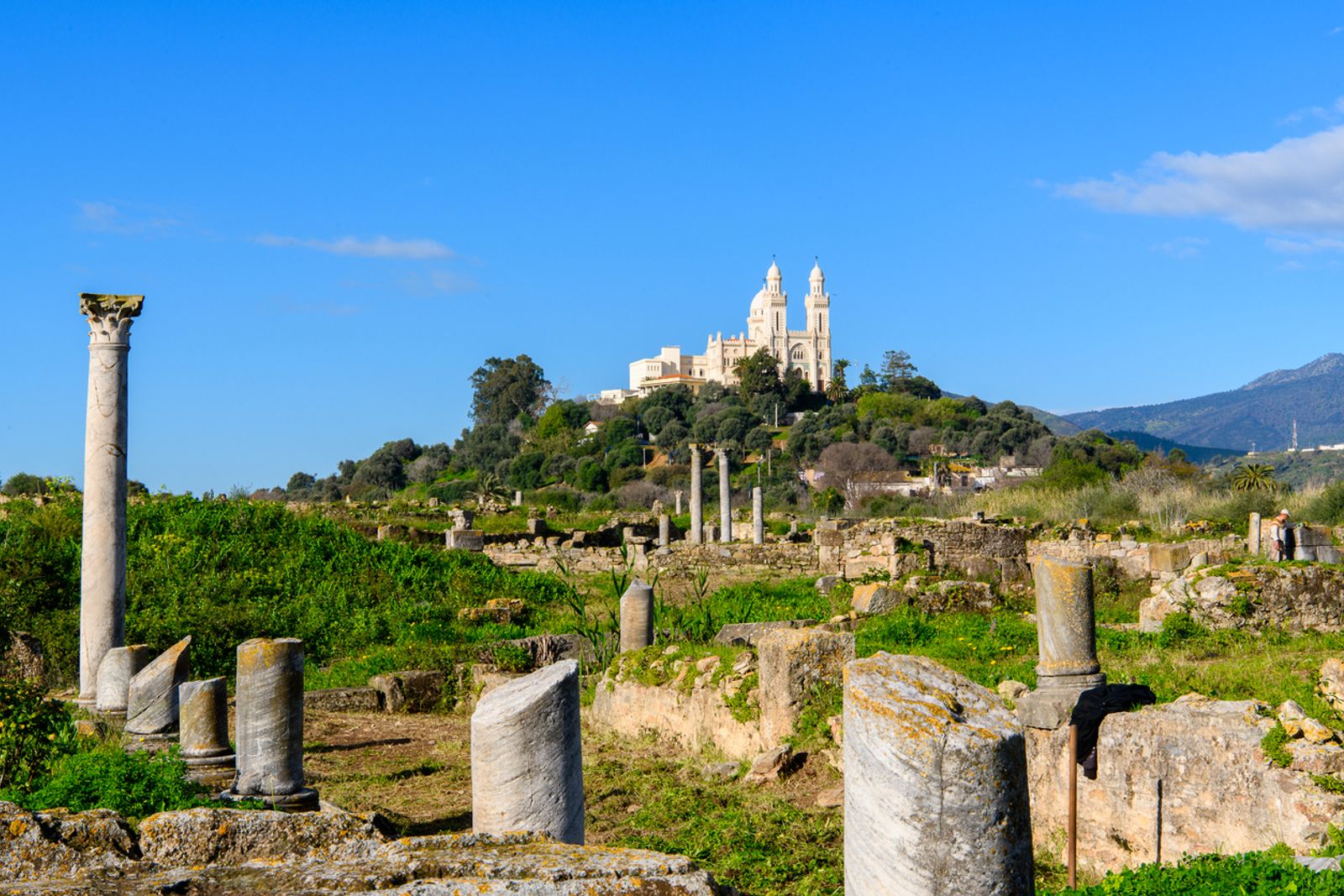
Later, visit the magnificent Basilica of St Augustine, an imposing church situated on a hill overlooking Annaba and the surrounding coastline.
The basilica commemorates the life and legacy of St Augustine and contains a relic traditionally believed to be part of his wrist bone.
From its elevated position, enjoy panoramic views across the city and Mediterranean Sea.
Return to your hotel following the sightseeing.
09Annaba to Algiers
Enjoy breakfast at your hotel, with some free time depending on your domestic flight schedule.
At the appropriate time, transfer to Annaba Airport for your flight back to Algiers.
The flight takes approximately 1 hour 15 minutes and currently operates daily, although exact departure times will be confirmed at the time of booking.
Upon arrival in Algiers, you will be met by your local representative and transferred to your hotel.
The remainder of the day is free to relax or explore the capital independently, providing an opportunity to revisit favourite locations or enjoy a final evening in Algeria.
10Departure from Algiers
Enjoy breakfast at your hotel, with any remaining time free to relax or explore independently, depending on your international flight schedule.
At the appropriate time, you will be transferred to Algiers International Airport for your onward journey, bringing your exploration of Algeria's remarkable Roman heritage to an end.
Take it with you
Download the example itinerary
Every trip is shaped around you, so treat it as a starting point.
Typically included and not
Included
- Nine nights' accommodation in the hotels specified in the itinerary, or similar, based on two people sharing a double or twin room.
- Meals as per the itinerary.
- All airport transfers and ground transportation as detailed in the itinerary.
- Private transportation for the overland journeys and included sightseeing excursions.
- Services of an English-speaking tour guide.
- Entrance fees to the archaeological sites, museums and attractions included in the programme.
- Domestic flight from Annaba to Algiers.
- Visa Support documents (Letter of Invitation)
Not included
- International flights to and from Algeria.
- Travel insurance.
- Algerian visa fees and any associated visa processing costs, unless otherwise confirmed.
- Meals not specifically mentioned in the itinerary.
- Personal expenses.
- Tips and gratuities for guides, drivers and other local staff.
Start planning your Algeria: Highlights of the Roman Ruins
Tell Emma Holmes when you'd like to go, how long for, and any specifics that matter. Typical reply within 24 hours, no enquiry fee, no pressure.
Start planning your trip